Wearable Health Monitor Solution
Solution Overview
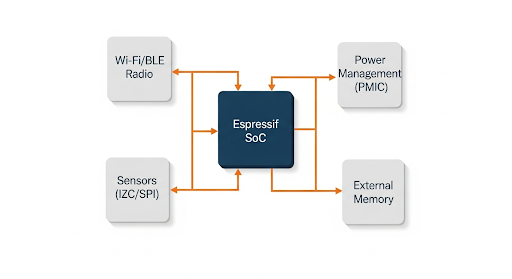
This reference design focuses on creating ultra-low-power wearable devices for health and fitness tracking. It uses the compact and power-efficient ESP32-C3 to gather data from various sensors (like heart rate and accelerometers) and transmit it via Bluetooth Low Energy (BLE) to a companion mobile app. The primary goal of this solution is to maximize battery life while maintaining reliable connectivity and accurate sensor readings.
Solution Block Diagram
Core Advantages
- Ultra-Low Power: Leverages the ESP32-C3's deep-sleep modes and efficient RISC-V core to achieve weeks of battery life.
- Compact Form Factor: Based on small footprint modules like the ESP32-C3-MINI-1, making it ideal for space-constrained wearable designs.
- Reliable BLE 5 Connectivity: Utilizes the features of Bluetooth 5 for faster data transfer and more stable connections to smartphones.
- Cost-Effective: The ESP32-C3 provides a highly integrated solution, reducing the overall Bill of Materials (BOM) cost.
Recommended Bill of Materials (BOM)
| Part Number | Description | Role in Solution |
|---|---|---|
| ESP32-C3-MINI-1 | Compact RISC-V Wi-Fi & BLE Module | Main processor, handling sensor polling, data processing, and BLE communication. |
| (External IC) | PPG Sensor (e.g., MAX30102) | For measuring heart rate and blood oxygen saturation (SpO2). |
| (External IC) | 6-Axis IMU (Accelerometer + Gyro) | For step counting and activity tracking. |
| (External IC) | LiPo Battery Charger IC | Manages the charging of the single-cell lithium battery. |
Application Scenarios
- Fitness Trackers and Smart Bands
- Continuous Heart Rate Monitors
- Smart Rings and other compact wearables
- Elderly Care and Patient Monitoring Devices